
 Albania
  Andorra
  Armenia
  Austria
  Azerbaijan
  Belarus
  Belgium
  Bosnia & Herzegovina
  Bulgaria
  Croatia
  Cyprus
  Czech Republic
  Denmark
  Estonia
  Finland
  France
  Georgia
  Germany
  Greece
  Hungary
  Iceland
  Ireland
  Italy
Italy  Kosovo
  Latvia
  Liechtenstein
  Lithuania
  Luxembourg
  Malta
Malta  Moldova
  Monaco
  Montenegro
  Netherlands
  North Macedonia
  Norway
  Poland
  Portugal
  Romania
  Russia
  San Marino
  Serbia
  Slovakia
  Slovenia
  Spain
Spain  Sweden
  Switzerland
  Turkey
  Ukraine
  United Kingdom
  Vatican City
  Bahamas
  Barbados
  Belize
  Canada
  Costa Rica
  Cuba
Cuba  Dominican Republic
  El Salvador
  Guatemala
  Haiti
Haiti  Honduras
  Jamaica
  Mexico
  Nicaragua
  Panama
  Puerto Rico
  Trinidad & Tobago
  United States
  Algeria
  Angola
  Botswana
  Cabo Verde
  Cameroon
  DR Congo
  Egypt
Egypt  Ethiopia
  Gabon
Gabon  Ghana
Ghana  Ivory Coast
  Kenya
Kenya  Lesotho
  Madagascar
  Malawi
  Mauritius
  Morocco
  Mozambique
  Namibia
  Nigeria
  Rwanda
  Senegal
  Seychelles
  Sierra Leone
  South Africa
  Sudan
Sudan  Tanzania
  Tunisia
  Uganda
  Zambia
  Zimbabwe
  Afghanistan
  Australia
  Bangladesh
  Brunei
  Cambodia
  China
China  Fiji
Fiji  Hong Kong
  India
India  Indonesia
  Iran
Iran  Iraq
Iraq  Israel
  Japan
Japan  Jordan
  Kazakhstan
  Laos
Laos  Lebanon
  Malaysia
  Maldives
  Mongolia
  Myanmar
  Nepal
Nepal  New Zealand
  Pakistan
  Papua New Guinea
  Philippines
  Qatar
Qatar  Saudi Arabia
  Singapore
  South Korea
  Sri Lanka
  Taiwan
  Thailand
  United Arab Emirates
  Uzbekistan
  Vietnam
  Argentina
  Bolivia
  Brazil
  Chile
Chile  Colombia
  Ecuador
  French Guiana
  Guadeloupe
  Guyana
  Martinique
  Paraguay
  Peru
Peru  Suriname
  Uruguay
  Venezuela

Gay Boston: History, Brownstones, and New England Pride
Boston's gay scene is one of the oldest and most historically grounded in the United States — a city where the LGBTQ+ community has been visible since at least the 1930s (Jacques Cabaret has been running since 1938), where ACT UP's Boston chapter was among the most active in the country during the AIDS crisis, and where the Massachusetts Supreme Judicial Court's 2003 ruling in Goodridge v. Department of Public Health made the state the first in the country to legalise same-sex marriage, effective 17 May 2004. That history shapes everything about Boston's gay scene: it is not the most commercially spectacular in the US, but it is among the most civically embedded, intellectually serious, and community-rooted.
The gay geography of Boston is tripartite. The South End, centred on Columbus Avenue and Tremont Street, is the primary LGBTQ+ residential and social neighbourhood — Victorian brownstones, restaurant row, Club Café as the community's living room, and a density of gay-owned businesses that gives the area its distinctive character. The Fenway neighbourhood, along Boylston Street near Fenway Park, has a second concentration of gay bars including Machine and Ramrod that reflect a more traditional leather and nightclub culture. Jamaica Plain, a neighbourhood south of the South End, is Boston's lesbian and progressive queer residential hub — the Midway Café on Washington Street anchors a community that has been quietly shaping JP's character for decades.
The South End: Boston's Gay Neighbourhood
The South End is one of the finest urban gay neighbourhoods in the United States — a Victorian brownstone district of extraordinary architectural quality whose gay identity developed in the 1970s as the community transformed what had been a declining residential area into the city's most desirable neighbourhood. The gentrification paradox that has played out in gay neighbourhoods across America is written clearly in South End real estate prices: the neighbourhood that gay residents rebuilt is now expensive enough that successive generations of gay residents are priced out, but the physical and cultural legacy remains.
Columbus Avenue is the central artery — restaurant row, café terraces, and the kind of pedestrian street life that Boston's other neighbourhoods often lack. Club Café at 209 Columbus is the hub: a combined restaurant and bar with multiple rooms that serves simultaneously as a dining destination, a video bar, and a performance venue for drag shows. The staff know the regulars; the food is actually good; the energy on a Friday evening is relaxed and social rather than performative. For a first-time visitor, an evening at Club Café is the orientation to Boston's gay scene.
Tremont Street runs parallel to Columbus and hosts the Fritz Lounge sports bar (in the Chandler Inn hotel), The Eagle Boston leather bar, and a concentration of gay-friendly restaurants and services. The cross streets between Columbus and Tremont — Chandler, Warren, Appleton — are the residential heartland, lined with federal-style and Victorian row houses that were largely renovated by gay homeowners and residents from the 1970s onward. Walking these streets at any time of day provides an encounter with Boston's gay history that no bar crawl can replicate.
Fenway: The Bar Corridor
Boylston Street in the Fenway neighbourhood hosts Boston's other concentration of gay bars, centred on the Machine/Ramrod complex at 1254 Boylston Street. Machine is the city's largest gay nightclub — multi-level, with different musical identities on each floor. Ramrod is the attached leather bar, a neighbourhood pub-style institution that serves the bear and leather community that has been on Boylston Street since the 1970s.
The Fenway location has a different character from the South End: more entertainment-district than residential-neighbourhood, closer to Fenway Park and the college-heavy Kenmore Square area. The proximity to the Red Sox stadium creates an overlap between the baseball-going public and the bar-going gay public on game nights that is particularly Boston in character. MBTA Green Line access (Fenway-Kenmore) makes the area reachable without a car.
Fenway Health at 1340 Boylston Street — one of the US's most significant LGBTQ+ health organisations, founded in 1971 — is the institutional anchor of the neighbourhood beyond the bars. The fact that the city's premier LGBTQ+ health centre and its premier gay nightclub share a street reflects the layered character of Boston's LGBTQ+ geography.
Jamaica Plain: The Lesbian Community
Jamaica Plain (universally called JP) is the Boston neighbourhood most associated with the city's lesbian community — a mixed residential area south of the South End with a progressive politics and demographic profile that has made it attractive to LGBTQ+ residents, particularly women, since the 1970s. The neighbourhood has gentrified significantly but retains its character: community gardens, independent businesses, a thriving restaurant scene on Centre Street, and the Midway Café on Washington Street as the cultural anchor.
The Midway Café is one of the most consistently excellent small music venues in the Boston area — live music seven nights a week, affordable cover, and a queer-friendly programming culture that includes regular women-identified and queer-specific nights that have drawn the JP community for decades. Women's Wednesdays, in particular, have been a consistent institution. The bar is not exclusively LGBTQ+ but the queer community presence is intrinsic to its identity.
For visitors staying in the South End, JP is accessible by MBTA Orange Line (Stony Brook station) or a fifteen-minute rideshare — worth the trip for an evening that reflects a different dimension of Boston's queer community.
Historical Roots
Boston's LGBTQ+ history runs deeper than its scene. Jacques Cabaret on Broadway has been operating since 1938 — through the McCarthy era, the pre-Stonewall 1960s, and the entire arc of the modern gay rights movement. The fact that it survived is remarkable; the fact that it continues to operate as a cabaret drag bar is a minor miracle of cultural continuity.
The AIDS crisis hit Boston's gay community hard — the city had one of the highest rates of HIV infection in the US in the 1980s — and ACT UP's Boston chapter was among the most active in the country, organising demonstrations, die-ins, and political campaigns that contributed to the movement that transformed AIDS research and treatment. Fenway Health's work during this period, including pioneering clinical research and community care, was central to the Boston community's response.
The marriage equality story began here. On 18 November 2003, the Massachusetts Supreme Judicial Court ruled in Goodridge v. Department of Public Health that the state constitution required equal marriage rights for same-sex couples — the first such ruling by a state supreme court. On 17 May 2004, the first same-sex marriages took place in Massachusetts. For many LGBTQ+ people around the world, that date has a significance comparable to Stonewall. Cambridge City Hall was the site of many of those first marriages, and the queue of couples waiting for licences on the morning of 17 May 2004 is one of the iconic images of American LGBTQ+ history.
Harvard, MIT, and Academic Boston
Boston's concentration of universities — Harvard, MIT, Boston University, Boston College, Tufts, Northeastern, and dozens of smaller institutions — creates an intellectual environment that shapes the character of the city's LGBTQ+ community. The Harvard and MIT LGBTQ+ resource offices, student organisations, and alumni networks are substantial and internationally connected. Academic conferences, LGBTQ+ studies programmes, and the general culture of the university city — where ideas are taken seriously and social issues are analysed as well as lived — all contribute to a queer community that tends toward the cerebral.
For visitors engaged with LGBTQ+ scholarship, activism, or cultural production, Boston's academic environment provides a backdrop that enriches the social scene. The Harvard Square area, while not specifically a gay district, is LGBTQ+-friendly in the way that university districts generally are, and the Brattle Theatre is one of the festival venues for the Boston LGBT Film Festival each spring.
Boston Pride
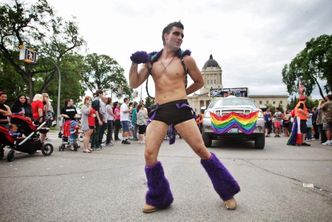
Boston Pride takes place across a week in early June, with the signature parade — one of America's oldest Pride marches — running through Copley Square and along Boylston Street on the second Saturday. The event draws 150,000+ participants and spectators, reflecting the scale of Massachusetts' LGBTQ+ community and its historical significance as the state where same-sex marriage began.
Boston Pride has particular emotional resonance in a city where the march to equality was long and the victories were hard-won. The route through Copley Square — past Trinity Church and the Boston Public Library, with the John Hancock Tower looming above — runs through a neighbourhood where Boston's civic identity is written most clearly. The Pride march here is inseparable from the city's broader identity as a place where civil rights battles have been fought and won.
Practical Guide
Getting there: Logan International Airport (BOS) is 5km from downtown Boston — the closest major airport to a city centre in the US. The MBTA Silver Line (bus rapid transit) runs directly from all terminals to South Station in Downtown Crossing, with connections to all MBTA lines. A taxi or rideshare from Logan to the South End takes 15–20 minutes depending on traffic. Amtrak Acela connects Boston to New York (under 4 hours) and Washington DC.
Getting around: Boston is one of the most walkable American cities and has the oldest subway system in the US — the T, operated by the MBTA. The Red, Green, Orange, and Blue Lines provide comprehensive coverage. The South End is best reached via Orange Line (Back Bay station) or Green Line (Copley). Fenway is on the Green Line (Fenway-Kenmore). Jamaica Plain is on the Orange Line (Stony Brook or Green Street). Most of the South End is walkable from Back Bay station in under 10 minutes.
When to visit: June for Boston Pride (book accommodation 3–4 months in advance). September–October for ideal weather and fall foliage, which transforms Boston and the surrounding region. April–May for the LGBT Film Festival and the beginning of the outdoor season. Avoid January–March: Boston winters are cold, snowy, and wind-driven — functional but not pleasant for tourism.
Winter reality: Boston winters are genuinely harsh — average temperatures below freezing January through February, regular snowfall, and the wind off the Charles River that makes actual temperatures feel colder. The LGBTQ+ scene operates year-round regardless of weather (Bostonians are accustomed to their winters), but the outdoor café culture and the sense of the city opening up that makes Boston most beautiful does not arrive until April or May.
Fenway and Red Sox culture: For visitors interested in the intersection of Boston sports culture and LGBTQ+ life, the proximity of the Fenway gay bar district to Fenway Park creates something unique. Red Sox games on Boylston Street, with the bars filling pre- and post-game, is an authentically Boston LGBTQ+ experience — the city's sports passions are shared across the community without contradiction.